Floor care supplies: strippers, finish, sealers, pads and drivers
Floor care in the Valley runs on a calendar, and the biggest date on it is the day school lets out. Strippers, finish, pads and drivers all move at once, so the aisle is stocked deep and the truck leaves with pallets.
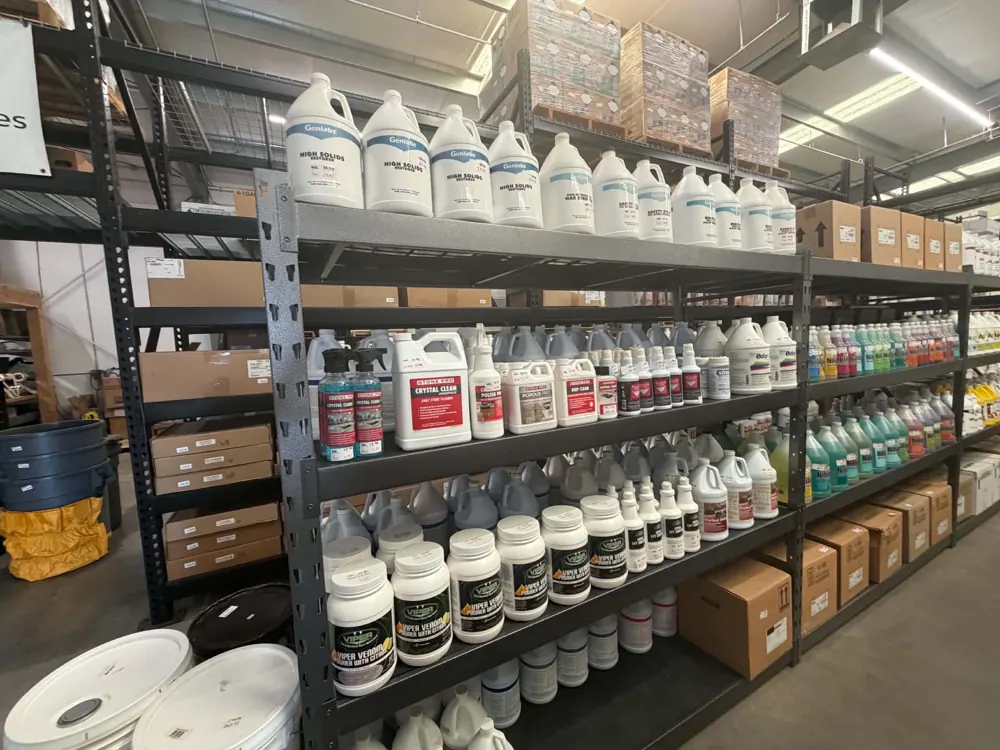
On the shelf for this work
 MCB17B17" Blue Microfiber Loop Pile Carpet Bonnet$27.98 /each
 SP17-CTN17" High Profile Cotton Carpet Bonnet$33.98 /each
 SP1717" High Profile Rayon Blend Carpet Bonnet$28.98 /each
 NBP17G17" Synthetic Blend Low Profile Bonnet with Scrub Strips$31.98 /each
 MCB19B19" Blue Microfiber Loop Pile Carpet Bonnet$31.98 /each
 SP19-CTN19" High Profile Cotton Carpet Bonnet$36.00$26.00 /each
 SP1919" High Profile Rayon Blend Carpet Bonnet$33.00$26.50 /each
 NBP19G19" Synthetic Blend Low Profile Bonnet with Scrub Strips$39.00$29.00 /each
The summer floor season
School lets out in early June, and until the first week of August most campuses in Fresno, Central and Clovis unified districts are empty. That window is when hallways, cafeterias and classrooms get stripped, sealed and refinished. Crews that normally clean at night are working days, and everyone orders at once.
The practical result is that stripper, finish and pads sell fast in June and July. If you run a floor crew, the smart move is to order early, spread the delivery across route days, and keep pad stock above what you think you need, because pads wear out on strip jobs faster than anywhere else. Mid-July heat also changes the work: finish dries faster in an unconditioned school, which affects how many coats you can get down before the afternoon.
Outside school work, the same calendar applies in smaller form: medical offices, churches and retail stores prefer to strip and wax on a long weekend or a closed week. Counter staff can tell you which items tend to run short in peak weeks, and the live stock counts show it in real time.
Winter has its own pattern. Tule fog brings damp air that slows finish drying and makes a floor feel tacky for longer, and wet shoes track grit through lobbies for weeks. Crews who refinish in December plan for extra dry time and keep fans running, and the maintenance schedule tightens up to match.
Stripping: the floor decides the stripper
A stripper has to match what it is removing and what is under it. Heavy buildup of multiple coats of finish needs a stronger product than a floor that is just scuffed. The aisle carries ammonia-based strippers, non-ammoniated options, and no-rinse strippers for jobs where rinsing is awkward or the water cannot reach.
Dwell time does most of the work. A stripper put down, left alone for the label time, and then agitated with a black pad or a heavy brush loosens finish with far less effort than one scrubbed immediately. Keep the floor wet, work in sections you can finish, and rinse thoroughly with clean water, because leftover stripper residue is what causes finish to fail.
Our strip-and-wax quantities guide helps you estimate how much stripper and finish a floor will take from the square footage. Start there before you order, so you do not run out partway through a gym floor.
Wear the gear the label asks for. Stripper is caustic enough to burn skin, and a wet floor is slippery for everyone, including the person holding the machine. Goggles, gloves, boots and wet-floor signs are part of the job, and the aisle next door carries most of them.
Finish, sealer and how many coats
Finish is the layer your customer sees. A good job is typically several thin coats rather than a few thick ones, each allowed to dry before the next goes down. Thick coats cloud, trap moisture and peel. The finish section carries floor wax and finish in several gloss and durability grades, from budget coats for low-traffic areas to harder, longer-wearing formulas for halls and lobbies.
Sealers go under the finish on porous floors, such as bare concrete, some vinyl composition tile and stone. They fill the pores so finish sits on top instead of soaking in. The ten sealers on the shelf cover different substrates, so check which one your floor needs.
Always check the finish and sealer you are using are compatible with the floor and with each other, and test an area if the floor is unfamiliar. The product page lists mix ratio, pH and hazard information, and the label is the final word on application and recoat times.
Humidity and temperature matter more than people expect. A Valley classroom in July can be hot and dry or cold and damp depending on whether the air handler is running, and finish behaves differently in each. Ask whether the building will be conditioned during the job before you plan the coats.
Pads by color and purpose
Floor pads are color coded by aggressiveness, and while manufacturers vary, the pattern is consistent: black and brown pads are for stripping, green and blue for heavy scrubbing and cleaning, red for spray buffing and everyday cleaning, and white for light polishing. Natural-fiber and higher-speed pads are for burnishing. Check the box, because colors are conventions, not standards.
Use the least aggressive pad that does the job, and change pads before they glaze. A loaded pad polishes dirt into the finish. Strip pads wear fast and should be flipped and replaced on a schedule; buff pads last longer but pick up grit that scratches the floor.
The hardsurface aisle carries floor pads, utility pads and bonnets, so a crew can outfit a full machine in one stop. Match the pad diameter to your machine, and ask the counter about thickness if you run a high-speed burnisher.
Keep a bucket of water and a brush at the end of the job and clean the pads before they dry. A pad that is rinsed while it is wet lasts several jobs, and one that is left to harden in a bucket goes to the dumpster.
Pad drivers and the machines under them
The pad driver is the plate the pad sticks to, and it is the part most crews forget until the pad flies off. Drivers come with different grippers and surfaces, in sizes that match standard floor machine diameters. A worn driver spins the pad off-center and leaves swirl marks you cannot buff out.
Twelve different pad drivers are on the shelf, so you can replace one that is worn or swap a machine over to a different type of pad. Bring the old one if you are not sure which fits; the counter can match it.
If you are looking for the machine itself, the equipment aisle has rotary floor machines in the standard sizes, orbital and walk-behind units, and scrubbers. For a crew that does strip jobs once or twice a year, the better call may be to buy the pads and drivers and rent or borrow the machine.
Stone, tile and grout
Stone and tile need their own care. Marble and limestone are acid-sensitive and etch under the wrong cleaner. Granite is tougher but still needs a pH-appropriate product. Grout is porous and holds soil, so it needs a cleaner that gets into the lines and a sealer that keeps it clean afterward. The aisle carries stone care products, a tile and grout cleaner line, and polish.
Most failures come from using the wrong product, or from using an acidic cleaner on stone to save time. Our tile, grout and stone mistakes guide covers the common errors, and the best way to avoid them is to identify the stone before you buy.
Burnishing and buffing are different things. Buffing uses a lower-speed machine and a pad to clean and refresh the finish, while burnishing uses a high-speed machine to harden and gloss the surface. Both need a finish that is built for the process, so confirm that before you start.
Stone and grout work also rewards patience. Wet the surface, let the cleaner sit for the label time, agitate with a brush that suits the surface, and pick up the slurry before it dries. Rushing any of those steps is how a bathroom floor ends up streaked.
Pails, pallets and the route
Floor care product is heavy. A five-gallon pail of finish or stripper weighs around forty pounds, and a pallet is a lot of weight. That makes delivery especially useful: the truck takes the lifting out of the day.
The route covers Fresno, Clovis, Sanger and Fowler every weekday, Selma, Kingsburg, Dinuba, Reedley, Visalia, Tulare and Hanford on Tuesday and Thursday, and Madera on Wednesday. Order by 11:00 AM for the next route day, free over $150 on the route. For summer work, schedule drops a day ahead of the job.
Outside the route, orders ship UPS Ground when placed by 2 PM, with free shipping over $300. Anything over 150 pounds goes LTL on a pallet. Chemicals ship ground only, and some products cannot ship, as the product page notes. Special orders can be placed at the counter for items off the shelf.
Floor care supplies by town
Questions we get at the counter
How do I know which floor stripper to buy?
Match it to the buildup and the floor. Heavy multi-coat buildup usually calls for a stronger stripper, light scuffing needs less, and no-rinse strippers suit jobs where rinsing is difficult. Check the label for compatible floor types. If you are not sure what is on the floor, test a small area first, and the product page lists the pH and mix ratio.
How many coats of floor finish should I apply?
Several thin coats are better than a few thick ones. Commercial jobs often use three to five depending on the floor, the finish and the traffic. Let each coat dry fully before the next, follow the label’s recoat time, and make sure the stripper was rinsed thoroughly. Our strip-and-wax quantities guide shows how much product a floor needs.
What do the floor pad colors mean?
Pads are color coded by aggressiveness. Black and brown are generally for stripping, green and blue for scrubbing, red for spray buffing and cleaning, and white for polishing. Burnishing uses its own high-speed pads. Manufacturers vary, so read the package, and use the least aggressive pad that does the work.
Do I need a sealer under floor finish?
On porous floors, such as bare concrete and some stone or tile, a sealer keeps finish from soaking in and gives it a base to sit on. On sealed resilient floors it is usually not needed. Check the label of both the floor and the finish, and ask the counter if you are unsure about the substrate.
What is the difference between buffing and burnishing?
Buffing is a lower-speed process that cleans and refreshes the finish with a pad. Burnishing runs a high-speed machine with a specific pad to harden and gloss the finish. Burnishing needs a finish designed for it and a machine rated for the speed. Both can extend the time between full strips.
When should schools order floor care supplies for summer?
Early. Strip and refinish work lands between early June and the first week of August, so stripper, finish and pads sell fast in that window. Place orders in May if you can, spread deliveries across route days, and confirm stock counts on the product pages. We can hold special orders for items not on the shelf.
Who buys this from us
- school district custodial crews
- floor care contractors
- custodial contractors
- medical and retail facility managers
- church facility teams
- tile and stone care specialists